
Measuring Brand Protection ROI: 3 Ways to Prove the Value of Your Investment
Investing in brand protection acts like an umbrella shielding your business from the storm of counterfeits and brand abuse. By proactively protecting your brand’s reputation and revenue streams, you prevent costly damage before it happens.
B2B decision-makers regularly face pressure to defend the budget for brand protection. The challenge is that security measures can look like a sunk cost until you connect them to a clear return on investment (ROI). Brand protection delivers measurable, quantifiable benefits to your bottom line. You just need the right framework to capture them.
The global scale of the threat makes the stakes concrete. Counterfeit and pirated goods were projected to reach an estimated $4.2 trillion in value according to International Chamber of Commerce projections, and companies lose around $500 billion every year to fake products according to U.S. Chamber of Commerce estimates. Both figures reflect ongoing losses, not projections. Real revenue leaves legitimate businesses through large marketplaces like Alibaba and similar channels, where brand enforcement remains complex.
This guide covers three data-driven methods for measuring brand protection ROI: quantifying revenue recovered from anti-counterfeiting enforcement, measuring the financial impact of preserved customer trust, and calculating cost savings and risk avoidance. Each method includes formulas, worked examples, and guidance on sourcing inputs — so you can build an ROI case that holds up to scrutiny from any finance or legal team.
TL;DR
- Counterfeit and pirated goods cost brands hundreds of billions of dollars each year. Brand protection ROI is real, measurable, and defensible to finance teams.
- Three methods cover the full picture: revenue recovered from enforcement takedowns, customer trust and retention preserved, and cost savings plus avoided legal risk.
- Four core formulas connect enforcement data to dollar figures that stakeholders can audit independently, even with imperfect starting data.
- Conservative inputs build credibility. Start at the low end of each range and refine the model as program data accumulates over time.
- Document every assumption with a clear data trail so your ROI case holds up across budget reviews and due diligence processes.
How to Calculate Brand Protection ROI: Formulas and Frameworks
Before working through the three measurement approaches below, it helps to understand the core formulas that make brand protection ROI calculations credible to finance teams. Each formula maps to a specific type of value your program generates, so stakeholders can replicate and audit the numbers independently.
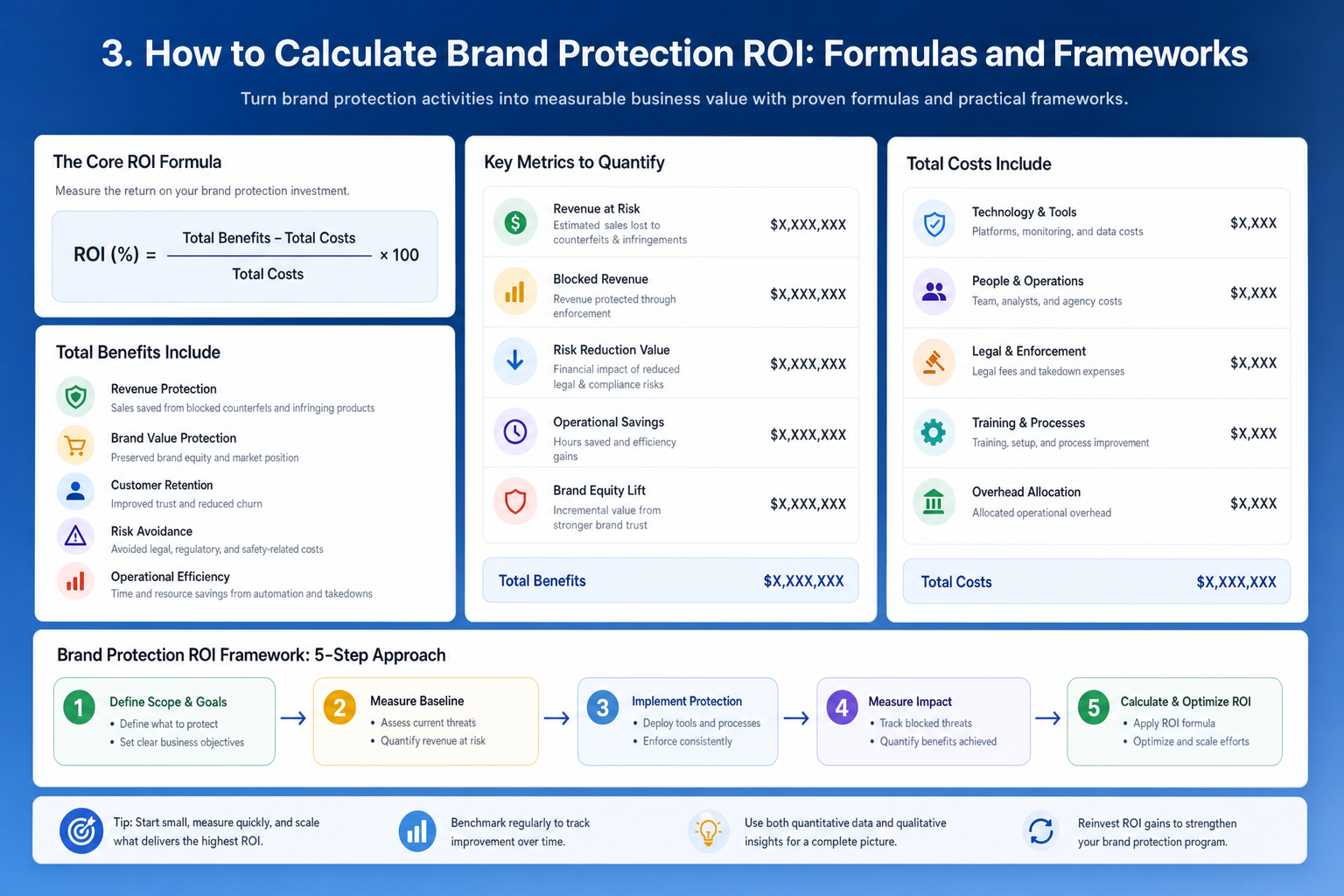
Formula 1: Basic ROI
ROI (%) = [(Total Value Gained - Program Cost) / Program Cost] x 100
Example: Your program costs $50,000 per year. You recovered $180,000 in revenue and cost savings combined. ROI = [(180,000 - 50,000) / 50,000] x 100 = 260%.
Formula 2: Revenue Recovery Rate
Revenue Recovered = Counterfeit Sales Value Removed x Lost Sale Rate
Example: $178,000 in counterfeits removed x 45.7% lost sale rate = $81,346 in recovered revenue. This is the core input for Method 1 below.
Formula 3: Cost Avoidance ROI
Cost Avoidance = (Hours Saved x Hourly Labor Rate) + Legal Costs Avoided + Risk-Adjusted Loss Prevention
Example: 80 hours per month saved at $100/hour = $8,000 per month, or $96,000 annually from labor savings alone — before counting legal fees avoided.
Formula 4: Customer Lifetime Value at Risk
CLV at Risk = (Customers Exposed to Fakes x Defection Rate) x Average Customer Lifetime Value
Example: 500 customers exposed to counterfeits x 15% defection rate x $2,000 CLV = $150,000 in customer value at risk per quarter.
Together, these four formulas give your team a replicable framework. You do not need perfect data to begin. Use the conservative end of each range for your first report, then refine your estimates as program data accumulates. The three sections below walk through each formula in detail, covering where to source inputs, how to handle assumptions, and which benchmarks to compare against.
1. Quantify Revenue Recovered from Anti-Counterfeiting Efforts
One of the most direct ways to measure brand protection ROI is by calculating the revenue you recover or retain by removing counterfeit goods and other infringing products from the market. Counterfeit sales directly siphon money that should belong to the legitimate brand. By taking down fake listings and enforcing your intellectual property, you can redirect those sales back to your company. To quantify this impact, consider the following approach:
Understanding Hard vs. Soft ROI Metrics
Before running the numbers, it pays to distinguish between the two types of value your brand protection program produces. Hard ROI metrics are those you can measure directly from enforcement data and financial records. Soft ROI metrics require modeling or proxy indicators, but they are no less real in terms of business impact.
Hard ROI metrics (directly measurable):
- Counterfeit listing revenue removed from the market
- Recovered sales calculated via a lost sale rate model
- Labor hours saved by automated detection and takedown workflows
- Legal fees avoided by resolving infringements before litigation
- Mean Time to Removal (MTTR), which tracks how fast threats are neutralized
Soft ROI metrics (modeled or inferred):
- Customer trust scores and Net Promoter Score (NPS) changes after enforcement campaigns
- Brand equity preserved by preventing counterfeit market saturation
- Reduced customer defection risk when fake product incidents are blocked
- Intellectual property asset value protected from dilution
Finance teams respond best when you lead with hard metrics and use soft metrics to frame the full picture. Start by anchoring your ROI case in the revenue recovery figures below, then layer in the customer trust and risk avoidance arguments from sections 2 and 3 to show the complete value of your program.
- Calculate the Sales Value of Counterfeits Removed: Start by estimating the total sales that counterfeiters generated from fake versions of your products. For example, suppose your enforcement actions in a given period took down fake listings that had been selling your product. Add up the estimated revenue of those counterfeit sales (e.g. shutting down unauthorized sellers who had sold $200,000 worth of knock-offs). Many brand protection solutions provide reports on the “value” of counterfeits removed, often based on the counterfeit’s price and volume sold. This figure represents the potential revenue that was going to illegitimate sources.
- Estimate Your Lost Sale Rate: Not every counterfeit sale translates 1:1 to a lost sale of a genuine product, some buyers of cheap fakes might never have purchased at full price. To be realistic (and conservative), estimate the percentage of those counterfeit sales that would have converted to real sales if the counterfeit had not been available. This percentage is often called the lost sale rate. It depends on factors like price difference and customer behavior. If the fake product was much cheaper than yours, the lost sale rate will be lower (many of those customers might not have paid full price); if the fake’s price was similar to your authentic product, the lost sale rate could approach 100%. In other words, the closer the counterfeit’s price is to the real thing, the more likely each fake sale represents a lost customer who thought they were buying your brand.
- Convert to Recovered Revenue: Multiply the counterfeit sales value by the lost sale rate to estimate how much genuine revenue was recovered (or preserved) by eliminating those fakes. This figure represents the direct ROI in terms of sales that your brand protection efforts secured. As a worked example: suppose a company enforced against $178,000 worth of counterfeit goods. Assuming a calculated lost sale rate of about 45.7% (based on the counterfeit being priced well below the authentic product), this translates to approximately $81,364 in revenue returned to the legitimate brand. In practical terms, that $81K is revenue that your company regained thanks to brand protection. If the cost of your brand protection program is less than this amount, the ROI is clearly positive.
By following this method, you create a concrete dollar figure for ROI. It essentially answers: "How much more money did we make (or how much did we save from being lost) because we removed these infringements?" You can further refine this by using different scenarios. For instance, you might calculate a conservative ROI (using a lower lost-sale rate to err on the safe side) versus an optimistic scenario. recommends using a conservative approach as a minimum return on revenue - the lower the assumed conversion rate of counterfeit buyers to real buyers, the higher your real ROI will be when you prove even that baseline value exceeds your costs. This conservative estimate helps withstand scrutiny from finance teams. On the other hand, a more "realistic" scenario can include additional factors (pricing, stock availability, number of incidents) for a granular estimate. No matter the method, tying counterfeit takedowns to recovered sales provides a measurable metric that speaks directly to financial stakeholders.
Example: Calculating Revenue Recovery ROI
A consumer electronics brand ran a single enforcement sweep and removed counterfeit listings with a combined sales value of $178,000. The brand's authentic product was priced 55% higher than the counterfeits, producing a calculated lost sale rate of 45.7%. Applying Formula 2: $178,000 x 45.7% = $81,346 in recovered revenue. The brand's annual brand protection program cost was $50,000. Applying Formula 1: [(81,346 + 14,000 in labor savings) - 50,000] / 50,000 x 100 = ROI of 91%, from one enforcement campaign alone. Conservative inputs, real numbers, auditable math.
Brand Protection ROI Metrics by Industry
2. Measure the Impact on Brand Trust and Customer Retention
Not all ROI is immediately reflected in a sales ledger. Brand protection's biggest payoff may be in safeguarding your brand's reputation, customer trust, and loyalty, which in turn protects future revenue. In a B2B context, preserving customer trust and brand equity is central to long-term success, even if it's trickier to quantify. However, there are ways to measure and justify these "soft" ROI factors with data and clear reasoning, particularly when implementing global trademark abuse prevention systems that protect your brand across international ecommerce platforms.
Start by recognizing the cost of not protecting your brand: if counterfeit or pirated products flood the market, customers can be deceived and disappointed, which erodes their trust in your company. Studies have shown that this trust erosion is dramatic. According to research by Incopro, two-thirds (66%) of consumers who were ripped off after unintentionally purchasing counterfeit goods lost trust in buying from that brand again. In other words, a single bad experience with a fake can alienate a loyal customer. Beyond that, 76% of shoppers say they would be less likely to buy from a brand if it's known to be regularly associated with counterfeit goods. Brand abuse directly drives customers away, affecting both reputation and future sales. The ROI of brand protection here is about the revenue you preserve by keeping those customers' confidence intact.
Metrics to Track Customer Trust ROI
To quantify this, track three specific metrics (complaint volume tied to fake products, brand sentiment scores such as NPS, and customer retention rate) and connect changes in each to your brand protection enforcement activity:
- Customer Complaints or Support Tickets Related to Fakes: Monitor how many customer service issues arise from people unwittingly buying counterfeits or encountering brand impersonation scams. If your brand protection program is working, these incidents should decrease. A decline in counterfeit-related complaints suggests that fewer customers are being disappointed by fakes – meaning fewer lost customers. You can quantify the value by estimating the lifetime value of those customers you retained because they didn’t have a bad counterfeit experience.
- Brand Sentiment and Trust Scores: Many companies track Net Promoter Score (NPS), customer satisfaction, or brand sentiment via surveys. If counterfeits and scams are rampant, you might see dips in these scores or negative feedback about "quality" and "authenticity." By combating infringements, you protect your brand's good name, which should reflect in stable or improving sentiment metrics. For instance, if your NPS improves after implementing brand protection, that's an indicator of ROI. Even if it's not solely due to anti-counterfeit actions, you can link major enforcement sweeps or anti-fraud campaigns to any positive changes.
- Repeat Purchase Rate and Customer Retention: Customers who trust your brand's security are more likely to stick around. If brand protection stops counterfeiters from undercutting you or harming customers, you'll retain more business. Track metrics like customer retention rate or churn rate in markets where you've had counterfeit problems. A higher retention rate after crackdowns on fakes can be translated into dollars (e.g. X% improvement in retention might equal Y million dollars in additional annual revenue from returning customers). Protecting brand integrity means customers "continue to purchase from that business again and again with confidence", which is effectively revenue saved by avoiding attrition.
While putting an exact dollar value on brand trust can be challenging, you can show ROI through scenario analysis. For example: "If 10% of our customer base would defect or buy less due to encountering fakes, that could cost us $Z in lost sales. By preventing that scenario through brand protection, we avoid that loss, representing a strong ROI." Likewise, consider the value of your brand as an intangible asset. If your brand's equity (often measured in brand valuation studies) would diminish from widespread counterfeiting, that's effectively a hit to your company's market value. Brand protection helps maintain your brand's equity, which is an investment that preserves shareholder value.
Preserving customer trust goes beyond being a feel-good goal, as it has direct financial implications. Happier, confident customers mean repeat business and steady revenue, which more than covers the cost of a proven brand protection program.
3. Calculate Cost Savings and Risk Mitigation
The third angle to measure brand protection ROI is through the cost savings and risk avoidance that a good brand protection strategy provides. Effective brand protection does more than recapture revenue; it also makes your operations leaner and prevents costly incidents down the line. B2B organizations should look at how their investment in brand security is paying off in reduced expenses, improved response times, and avoided losses.
Here’s how to break it down:
- Time and Labor Saved: Consider the manpower required to manually detect and combat infringements across the web (marketplaces, social media, websites). A strong brand protection solution (or dedicated team) automates and accelerates enforcement. Measure how many person-hours are saved by using anti-counterfeiting software or specialists. For example, if your legal or compliance team used to spend 100 hours per month chasing down infringements and now, with a software platform, they spend 20 hours, that's 80 hours saved. You can translate that into monetary terms by assigning an average hourly rate, essentially a direct cost avoided. Those saved hours can then be redirected to other valuable tasks, increasing overall productivity.
- Reduction in Legal and Enforcement Costs: Proactively removing counterfeit listings and resolving IP issues early can dramatically cut down on expensive legal actions. Every lawsuit or cease-and-desist battle you avoid is money saved. A proactive brand protection program prevents legal issues from arising in the first place, sparing your company the burden of costly litigation and takedown efforts. For instance, using software to issue rapid takedowns globally might cost a fraction of what engaging lawyers and investigators for a single major counterfeit case would. notes that deploying brand protection software "minimizes legal costs associated with civil or commercial litigation" by resolving many infringements swiftly out of court. These savings contribute directly to ROI, as they are expenses you didn't have to incur thanks to your investment in brand protection.
- Faster Incident Resolution and Less Damage: Speed is money in brand protection. The quicker you can detect and stop a counterfeit seller or a brand impersonator, the less damage they can do to your sales and customer trust. By measuring the average time to detect and enforce on threats (and observing that it has gone down after investing in better tools/processes), you can infer how much loss has been avoided. For example, if previously it took 30 days to shut down a fake product listing and now it takes 5 days, that's 25 days of additional fake sales prevented. Those prevented fake sales are essentially losses averted, which you can add to your ROI calculation. Faster action also means fewer customers buy the fake in the first place, tying back to the trust and revenue metrics above.
- Value of Safeguarded Intellectual Property: Your trademarks, patents, and brand assets are valuable – losing control of them has long-term financial repercussions. Brand protection efforts that prevent IP infringement (such as stopping someone from hijacking your brand name on a rogue website or registering a similar domain) preserve the exclusive value of your IP. While harder to quantify, you can cite the replacement cost or potential licensing value of those IP assets. For example, if counterfeiters are kept at bay, you won’t need to invest in re-branding or defensive trademarks. In effect, money spent on brand protection is returned in the form of maintaining your IP’s full value.
Industry experts recommend tying these results to key performance indicators (KPIs) that matter to your business. For instance, The CMO Council suggests measuring brand protection ROI by tracking reductions in brand abuse incidents and revenue loss, time saved by your team, and the value of intellectual property safeguarded (thecmo). Regular reports can show cost savings, enforcement success rates, and improvements in customer trust, linking them to outcomes like increased sales or a stronger brand reputation (thecmo).
Essentially, you want to show that for every dollar invested in brand protection, you saved or gained X dollars through these combined benefits. Modern AI brand protection tools deliver these savings by automating detection and enforcement workflows that previously required extensive manual labor from legacy BPO providers.
Risk Mitigation and Avoided Costs
Risk mitigation is another critical part of ROI that often goes underappreciated until a crisis happens. By investing in brand protection, you are avoiding potentially catastrophic costs that come with unchecked brand abuse, such as a massive recall due to fake products, regulatory fines, or a PR crisis if counterfeit goods harm customers. It’s fair to include in your ROI argument that “an ounce of prevention is worth a pound of cure.” For example, if your brand protection program prevents a major counterfeiting operation that would have forced a recall (costing say $5 million), that $5M is value gained. Even though it’s an event that never happened, the financial logic is that your investment averted that risk. You can bolster this point with examples: luxury brands losing tens of millions to fakes, or pharma companies facing lawsuits over counterfeit drugs, and note that your brand protection measures help avoid those worst-case scenarios.
In summary, add up the various cost savings: labor savings, legal cost avoidance, faster time-to-response, and circumvented risks. These all contribute to a higher ROI. A good brand protection software should provide analytics to help here, for instance reporting how many infringements were removed (and the estimated cost if they hadn't been) and giving an "enforcement success rate" that you can compare against the program cost. If the software took down 500 incidents that would have taken your team months to handle, you can calculate the money saved by not stretching your internal resources. By showing that "we spent $X on brand protection, and saved $Y in costs and avoided losses", you present a compelling business case.
Documentation Best Practices for ROI Credibility
Calculating brand protection ROI is only half the job. Finance teams and executive stakeholders will closely review the numbers, so the way you document your methodology matters as much as the figures themselves. Well-structured records turn your ROI case from a one-time estimate into a repeatable, auditable report.
- Start with conservative estimates: Always anchor your baseline calculations at the low end of defensible ranges. Use a lower lost-sale rate, a shorter enforcement window, or a more modest labor-hour savings figure. A conservative number that holds up to scrutiny builds more credibility than an aggressive figure that invites pushback. You can present an optimistic scenario alongside it, but lead with the floor.
- Maintain a clear documentation trail: Record the data sources behind every input: counterfeit sales figures pulled from your brand protection software, hourly rates sourced from your finance team, legal cost benchmarks cited from published industry data. Stakeholders who want to verify the math should be able to trace every number back to its origin without asking you to reconstruct it.
- Build audit-ready reports: Store enforcement logs, takedown confirmations, and incident records in a structured format your legal or compliance team can access independently. These records also protect you if your brand protection investment is ever questioned during a budget review or an acquisition due diligence process.
- Report on a consistent cadence: Monthly snapshots of enforcement volume and time-to-removal, combined with quarterly ROI summaries, give leadership a reliable rhythm of data. Consistent reporting prevents the ROI conversation from becoming a one-off justification exercise and positions brand protection as an ongoing business function with measurable output.
- Update your baseline annually: As your program matures and enforcement data accumulates, revisit the assumptions behind your lost-sale rate and labor savings figures. Refining your model each year with real program data makes future ROI calculations more accurate and more persuasive.
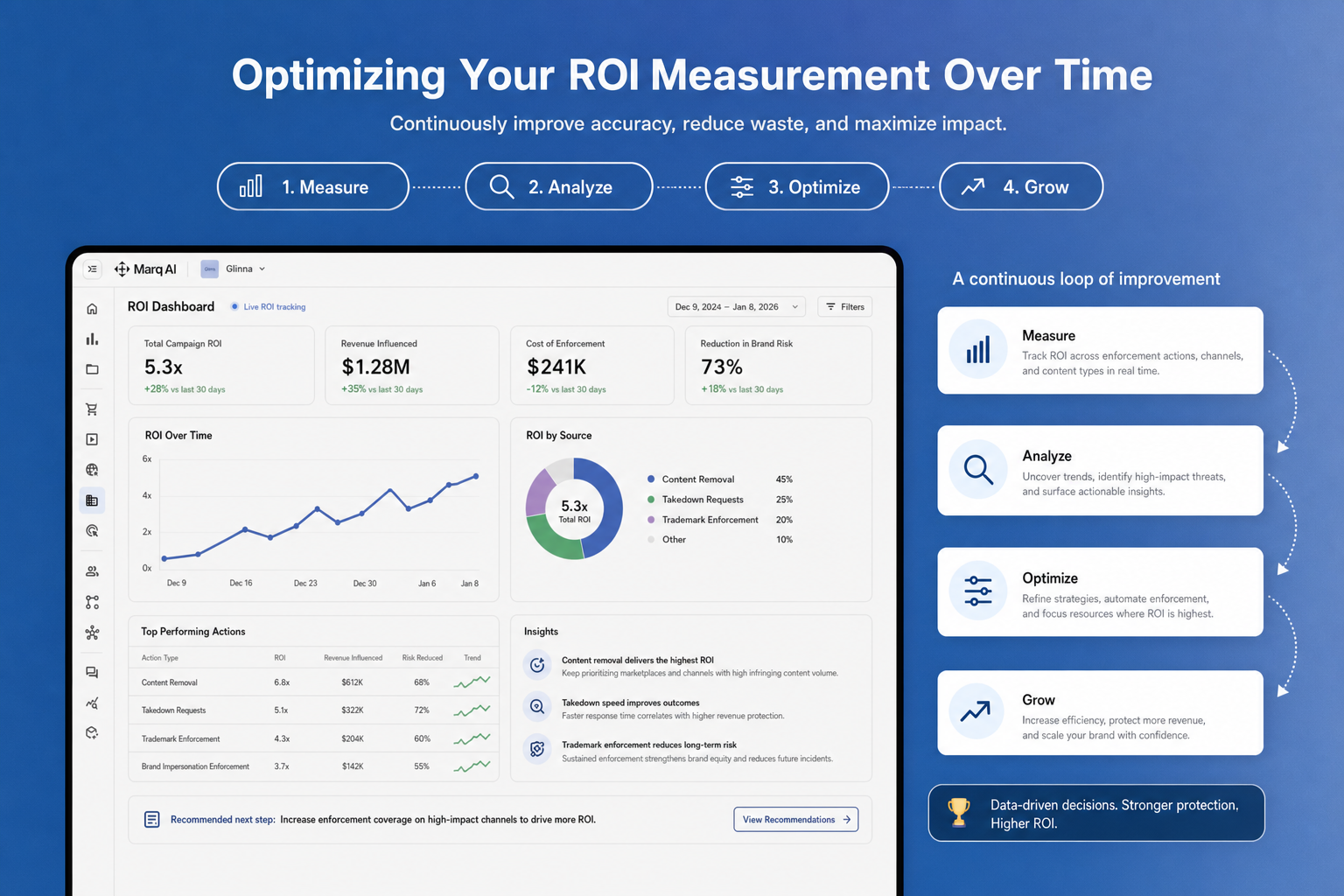
Optimizing Your ROI Measurement Over Time
A brand protection ROI model improves with use. The numbers you calculate in the first reporting cycle will carry more uncertainty than those built after a year of real program data. Building a habit of reviewing and refining your measurement approach is as valuable as the model itself.
- Set a review cadence that matches your program's maturity. Early-stage programs benefit most from monthly snapshots of enforcement volume and time-to-removal, since these inputs shift quickly and set the baseline for later calculations. As the program matures, quarterly ROI reviews give leadership a consistent rhythm without creating reporting fatigue. Annual deep reviews, covering lost-sale rate assumptions, labor savings figures, and legal cost benchmarks, keep the model grounded in current data.
- Refine your assumptions as data accumulates. Your initial lost-sale rate estimate will be drawn from published benchmarks or internal pricing analysis. Over time, transaction data from authorized channels, customer survey results, and enforcement logs give you the raw material to replace those estimates with program-specific figures. Each refinement makes your ROI case more defensible to finance and legal teams.
- Update your baselines when the business changes. A product line extension, a new market entry, or a pricing adjustment can shift both your counterfeit exposure and your lost-sale rate. Review the inputs behind your ROI model whenever a material business change occurs, outside of any fixed schedule.
- Track methodology changes over time. When you revise an assumption, for example updating your lost-sale rate from 45% to 52% based on new data, document the reason and keep the prior version for comparison. This creates an audit trail that builds trust with finance teams and protects you if the numbers are questioned during a budget review.
Conclusion: Proving the Value of Brand Protection
Brand protection is often viewed as a cost center, but by measuring ROI in the right ways, you can flip that narrative. Through the three approaches above, you've identified how protecting your brand translates into real financial gains: reclaimed revenue from counterfeit takedowns, ongoing income thanks to preserved customer trust, and measurable savings from cost reductions and risk prevention. When you present these metrics, use concrete numbers and examples, such as the thousands of dollars recovered from a major enforcement action, or the percentage increase in customer retention after anti-counterfeiting measures were implemented. By outlining these benefits, you tap into a common pain point for B2B decision-makers who need to defend their budgets.
By using the methods detailed above, you can confidently defend your brand protection investment, not as a mere cost, but as a smart strategy that pays for itself and then some.
Frequently Asked Questions About Brand Protection ROI
What is a realistic ROI target for brand protection software?
ROI varies by industry, enforcement volume, and program maturity, but a well-run program commonly delivers positive returns within the first year. In the consumer electronics example in this guide, a single enforcement campaign produced a 91% ROI against a $50,000 annual program cost. More mature programs with higher counterfeit exposure often report multiples of their investment once labor savings and legal cost avoidance are included. Start with conservative inputs and treat the first year as a baseline, not a ceiling.
How do I determine the lost sale rate for my product category?
The lost sale rate depends primarily on the price gap between your authentic product and the counterfeit. If a fake sells at a steep discount, fewer counterfeit buyers would have purchased at full price, so the rate is lower. If the fake is priced near your genuine product, the rate approaches 100%. You can model it using your authorized channel pricing, the counterfeit's observed selling price, and customer survey data if available. For a first estimate, industry benchmarks for your sector (fashion, electronics, pharma, auto parts) provide a defensible starting point. Refine it annually as enforcement data accumulates.
What data do I need before I can calculate brand protection ROI?
The core inputs are: the estimated sales value of counterfeit listings removed (from your brand protection software's enforcement reports), your lost sale rate assumption, your program's annual cost (software plus internal labor), and an average hourly rate for your legal or compliance staff. Optional but strengthening inputs include legal fee benchmarks, customer lifetime value figures from your CRM, and NPS or complaint volume data tied to counterfeit incidents. You do not need all of these to start. Even a calculation using just counterfeit sales value and a conservative lost sale rate produces a credible floor figure.
How often should I report on brand protection ROI?
Monthly snapshots of enforcement volume and mean time to removal work well for day-to-day tracking. Quarterly ROI summaries give leadership a consistent view without creating reporting fatigue. Annual deep reviews, where you revisit lost sale rate assumptions, labor savings figures, and legal cost benchmarks, keep the model accurate as your program and business evolve. The key is consistency: regular reporting turns ROI from a one-time budget justification into an ongoing business metric.
Can small or mid-sized brands make the case for brand protection investment?
Yes. The ROI framework in this guide scales with enforcement volume, not company size. A brand with modest counterfeit exposure but high product margins can still produce a strong ROI from a smaller program. The cost avoidance argument (legal fees avoided, labor hours saved) is often the most accessible entry point for smaller teams, since those savings are directly measurable against program cost without requiring complex lost sale rate modeling. Starting with a focused scope, one marketplace or one product line, and measuring returns there makes the business case concrete before expanding the program.
Stay up to date on the latest IP Protection content from MarqVision.




4 Enforcements a Week to 400: Scale Brand Safety with Marq AI

Don’t Just Find Counterfeits. Dismantle the Entire Network.

.png)
Discover the latest trends and challenges in IP protection

Take Control of Your Trademarks with MARQ Folio
Renew and Manage Your Trademarks Easily With MARQ Folio

We’re waiting to hear from you

See the best brand protection solution in action

Don’t let piracy steal your growth

Talk to us about your brand protection problems